
The digital world is becoming more competitive every year. In 2026, every business needs a strong online presence to reach the right people. A website alone is not enough. It must be visible, useful, fast, and trusted.
This is where seo strategies play an important role. They help a business improve search visibility and connect with users who are already looking for services or products. However, SEO is not only about ranking a page. It is about building a complete search presence.
Good SEO includes content, keywords, technical strength, backlinks, user experience, and trust. Therefore, businesses need a clear process that supports long term growth. The right plan can help a website attract more visitors and build better authority.
At EerkinsTech, SEO is seen as a full digital growth process. It supports business visibility, website performance, and customer trust.
Why SEO Strategies Matter in 2026
Search behaviour has changed. Users want quick answers and trusted websites. They compare businesses before they contact them. Also, search engines now focus more on helpful content and better page experience.
Because of this, seo strategies must be planned with care. A business should not only add keywords to a page. It should understand user intent, page quality, website speed, and online authority.
In 2026, businesses that use strong SEO methods can build better search value. They can also reduce their full dependence on paid ads. Paid traffic can stop when the budget stops. Organic traffic can support growth for a longer time.
A good SEO process gives a website structure. It helps every page serve a purpose. As a result, users can find clear answers and search engines can understand the website better.
Strategy 1: Build Content Around Real User Intent
Content is still one of the most important parts of SEO. However, content must answer what users actually need. This is called user intent.
User intent means the reason behind a search. Some users want information. Some compare services. Some are ready to contact a business. Therefore, content should match the search purpose.
A strong content strategy starts with understanding the audience. A business should know what people search for and what problems they want to solve. Then the website content should answer those needs in simple words.
For example, a service page should explain the service clearly. A blog should give useful information. A homepage should show the business value. Each page should have a clear role.
This is one of the most useful seo strategies because it supports both users and search engines. When content is helpful, visitors stay longer. Also, search engines can better understand the page topic.
Content Should Be Clear and Helpful
Good content should not be too complex. It should use short paragraphs and clear headings. It should avoid repeated ideas. Also, it should not overuse keywords.
A business can use seo keywords naturally in headings and text. However, the content should still feel human and useful. The main goal is to inform the reader.
Strategy 2: Use Smart Keyword Planning
Keywords help connect a website with search demand. They show what people are looking for. However, keyword use has changed. Search engines now understand context better.
In 2026, keyword planning should focus on meaning, not only exact words. A page should include the main topic and related terms. This helps the page feel complete.
For example, a page about SEO may include terms like seo marketing, content planning, backlinks, technical SEO, and search visibility. These terms help search engines understand the wider topic.
Good keyword planning also helps avoid confusion. Each page should target a clear subject. If many pages target the same keyword, they may compete with each other. So, keyword mapping is important.
Keyword Mapping Supports Page Focus
Keyword mapping means assigning the right keyword to the right page. A service page may target a service keyword. A blog may target an informational keyword. A contact page may focus on action based terms.
This process helps create a clean website structure. It also improves the value of seo strategies because each page works with a clear purpose.
Strategy 3: Improve On Page SEO and Website Experience
On page SEO is the work done inside a website. It includes titles, headings, content, internal links, images, page speed, and mobile design. These areas help users and search engines understand the website.
A strong website should be easy to use. Visitors should find important pages without confusion. Menus should be simple. Contact details should be clear. Pages should load quickly. Also, the website should work well on mobile phones.
This matters because users leave weak websites fast. If a page is slow or hard to read, it can reduce trust. Therefore, technical quality and user experience are now part of modern SEO.
Internal Links Help Users Move Through the Website
Internal links connect one page to another. They help visitors explore related content. They also help search engines understand page relationships.
For example, a blog can link to an SEO service page, homepage, or contact page. This creates a better journey for users.
If your business wants support with search growth, you can connect with an seo agency that understands both website structure and content planning.
Strategy 4: Build Quality Backlinks and Brand Authority
Authority is important in search. A website with useful content and trusted signals has a better chance to perform well. This is where seo backlinks matter.
Backlinks are links from other websites to your website. A trusted backlink can show that your content has value. However, backlink quality is more important than quantity.
Poor links can harm trust. Random links from weak websites may not help. Strong links usually come from relevant sources, useful content, business directories, guest content, PR mentions, and real partnerships.
This strategy should be done carefully. The goal is to build trust, not just collect links. A business should focus on quality content and real online presence. Over time, this can help attract better links.
Brand Mentions Also Support Trust
Backlinks are important, but brand mentions also matter. If people talk about your business on trusted sites, directories, or platforms, it can build recognition.
For local and service based companies, reviews and business listings can also support authority. Therefore, off page SEO should be part of wider seo marketing.
Strategy 5: Track SEO Performance and Improve Over Time
SEO is not a one time task. It needs tracking and improvement. Search trends change. Competitors update their websites. User behaviour also changes. Because of this, businesses must review results often.
Tracking helps a business see what works. It can show which pages bring traffic, which keywords are improving, and which pages need updates. It can also show technical issues that may affect performance.
Important areas to review include organic traffic, keyword rankings, page speed, click through rate, bounce behaviour, backlinks, and conversions.
This is one of the most practical seo strategies because it keeps the website active and improving. A website that is updated often can stay more relevant.
Content Updates Can Improve Long Term Value
Old content can lose value if it becomes outdated. Therefore, businesses should refresh important pages. They can update facts, add better examples, improve headings, and fix weak sections.
This keeps the content useful for users. It also helps search engines see that the page is maintained.
Why Businesses Need a Balanced SEO Process
The best SEO results come from balance. Content alone is not enough. Backlinks alone are not enough. A fast website without useful content may still struggle. A good SEO process connects all parts.
Strong seo strategies include research, content, on page work, technical checks, backlinks, and tracking. Each part supports the other.
For example, helpful content can attract links. A fast website can improve user experience. Better keywords can improve page focus. Strong internal links can guide users to service pages. Together, these actions build search strength.
At EerkinsTech, the focus is on building SEO that supports long term digital growth. The aim is to create better visibility, better website value, and better user experience.
If your business wants to improve search visibility in 2026, contact our team to discuss your website goals and online growth needs.
Conclusion
SEO in 2026 is more complete than before. It is not only about adding keywords or building links. It is about creating a useful website, strong content, trusted authority, and a better user journey.
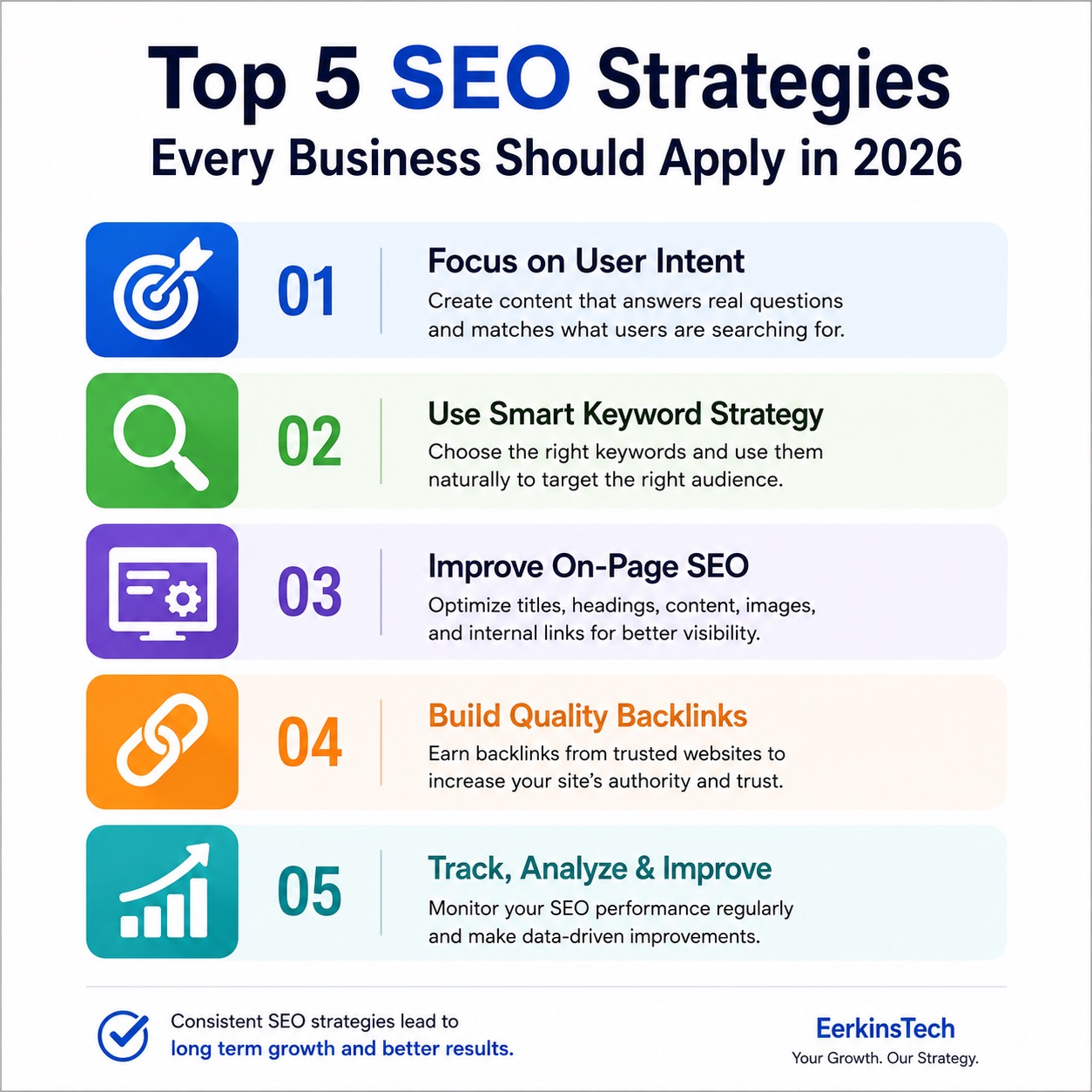
The top 5 seo strategies every business should apply include user focused content, smart keyword planning, strong on page SEO, quality backlinks, and regular performance tracking.
When these strategies work together, they can help a business grow online in a natural and steady way. A strong SEO process builds trust, improves visibility, and supports long term digital success.
FAQs
What are SEO strategies?
SEO strategies are planned actions that help a website improve search visibility. They include content, keywords, on page SEO, backlinks, technical checks, and tracking.
Why are SEO strategies important in 2026?
They are important because online competition is higher. Businesses need strong content, better website experience, and trusted authority to reach users through search.
What is the role of SEO keywords?
SEO keywords help connect website pages with user searches. They should be used naturally in content, headings, titles, and service pages.
Are SEO backlinks still important?
Yes, SEO backlinks are still important. However, quality matters more than quantity. Relevant and trusted backlinks can support website authority.
Can an SEO agency help with long term growth?
Yes, an SEO agency can help with research, content planning, website checks, backlinks, and performance tracking for long term search growth.