

Search visibility is important for every business in the digital world. A website may look good, but it still needs search strength to reach the right audience. This is why SEO matters for online growth.
When people talk about SEO, they often hear two main terms. These are on page seo and off page seo. Both are important, but both work in different ways. Therefore, understanding on page vs off page seo helps businesses know how search growth really works.
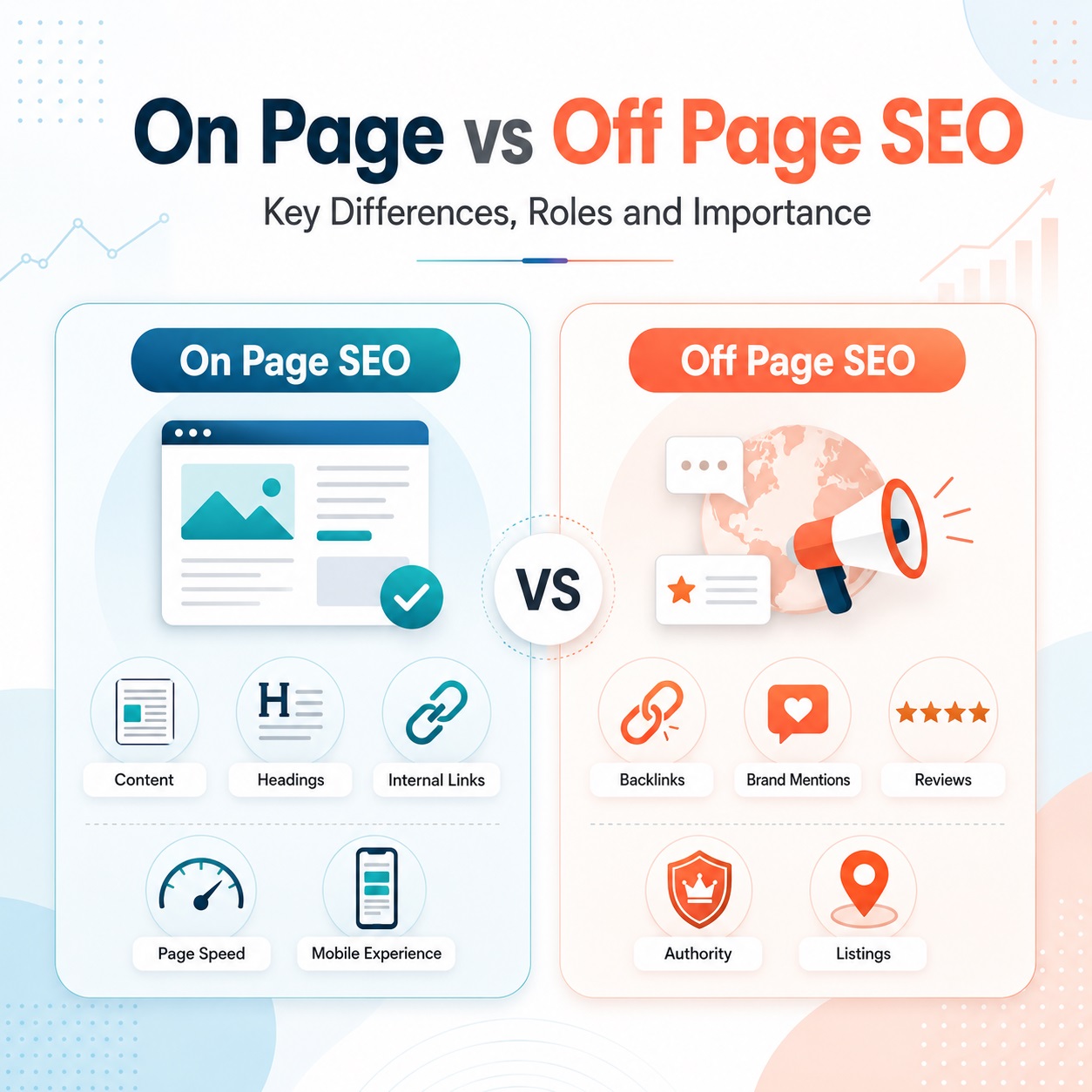
In simple words, on page SEO improves the website itself. Off page SEO builds trust outside the website. One focuses on content, structure, speed, headings, and internal pages. The other focuses on backlinks, brand mentions, authority, and online reputation.
Both parts support each other. A website needs strong pages, but it also needs trust signals from other places. Because of this, a balanced SEO plan should include both areas.
What Is On Page SEO?
On page seo means all improvements made inside a website. These changes help search engines and users understand the page better. It includes content, headings, keywords, images, page speed, internal links, and user experience.
For example, a service page should clearly explain what the business offers. A blog should answer the user’s question. A product page should describe the product in simple and useful words. As a result, users can understand the page quickly.
Search engines also read these signals. They check page titles, headings, content quality, links, and structure. So, on page SEO helps a website become clear, useful, and easy to rank.
In the topic of on page vs off page seo, on page work is the foundation. Without strong pages, outside promotion may not give good results.
What Is Off Page SEO?
Off page seo means activities that happen outside your website. These activities help build trust, authority, and online reputation. The most common part of off page SEO is backlinks.
Backlinks are links from other websites to your website. When a trusted website links to your page, it can send a positive signal. It shows that your content may be useful or reliable.
However, off page SEO is not only about backlinks. It can also include brand mentions, local listings, social signals, guest posts, digital PR, reviews, and business profiles. These signals help search engines understand how people see your brand online.
In on page vs off page seo, off page work supports authority. It helps your website look trusted beyond its own pages.
Main Difference Between On Page and Off Page SEO
The main difference is control. On page SEO is mostly in your control. You can update your content, fix headings, improve speed, add internal links, and make pages better.
Off page SEO is different. It depends more on outside signals. Other websites may link to your content. People may mention your brand. Customers may review your business. These signals are not fully controlled by you, but they can be improved with quality work and trust building.
Another difference is purpose. On page SEO helps search engines understand your pages. Off page SEO helps search engines trust your website.
So, when comparing on page vs off page, remember this simple idea. On page SEO builds page quality. Off page SEO builds website authority.
Key Areas of On Page SEO
Content Quality
Content is a major part of on page SEO. A page should be useful, clear, and relevant. It should answer what the user wants to know. Also, it should avoid repeated wording and keyword stuffing.
Good content keeps users engaged. It also helps search engines understand the topic.
Page Titles and Headings
Page titles and headings help organize content. They tell users what each section is about. They also help search engines read the page structure.
A good heading should be simple and related to the topic. It should not feel forced.
Keyword Placement
Keywords help connect content with user searches. However, they should appear naturally. For example, the phrase on page vs off page seo should fit where the comparison is discussed.
The goal is not to repeat keywords too much. The goal is to make the topic clear.
Internal Links
Internal links connect one page of a website to another. They help users explore more content. They also help search engines understand page relationships.
For example, a blog can link to SEO services, a homepage, or a contact page. This keeps users moving through the website in a useful way.
Page Speed and Mobile Experience
Users expect fast websites. If a page loads slowly, visitors may leave. Also, many users browse from phones. So, websites must work well on mobile devices.
Speed and mobile design are important parts of modern SEO.
Key Areas of Off Page SEO
Backlinks
Backlinks are one of the most known parts of off page SEO. A backlink from a relevant and trusted website can support authority.
Still, quality matters more than quantity. A few good links can be better than many weak links.
Brand Mentions
Brand mentions can also support online trust. If people talk about a business on other websites, blogs, directories, or platforms, it can help build recognition.
This is useful for companies that want to grow their name online.
Business Listings
Local and business listings help users find company details. These may include name, phone number, website, address, and service information.
Accurate listings can support trust and local visibility.
Reviews and Reputation
Reviews can affect how people see a business. Positive and real reviews can build confidence. They also help users make better decisions.
For service based companies, online reputation is very important.
Why Both SEO Types Are Important
A business should not choose only one side. Both are needed. If your website has strong content but no authority, it may struggle to compete. If your website has backlinks but weak pages, users may leave quickly.
This is why on page vs off page seo should not be seen as a fight. It should be seen as a partnership.
On page SEO makes the website useful. Off page SEO makes the website trusted. Together, they support better search visibility and stronger digital growth.
For example, if EerkinsTech writes a helpful blog, that is on page work. If another website links to that blog, that is off page work. Both actions can support ranking and reach.
How On Page and Off Page SEO Work Together
Search engines want to show useful and trusted results. On page SEO helps prove usefulness. Off page SEO helps prove trust.
A strong page with clear content can attract visitors. Also, if the page gives real value, other websites may link to it. This can improve authority over time.
In the same way, backlinks can bring users to a page. But if the page is weak, users may not stay. Therefore, both parts must match each other.
This is the real value of on page vs off page seo. One brings clarity. The other brings credibility.
Which One Should Businesses Focus On First?
Most businesses should start with on page SEO. The website should be clear before building authority. Content, service pages, internal links, speed, and structure should be improved first.
After that, off page SEO can support wider growth. Backlinks, listings, mentions, and reputation can help the website gain more trust.
However, the best result comes when both are handled together. A good SEO plan checks the website first, then builds outside signals in a natural way.
Professional SEO services can help businesses review both areas and build a balanced search plan.
Common Mistakes Businesses Make
Some businesses focus only on keywords. This can make content feel unnatural. Others focus only on backlinks and ignore website quality. Both mistakes can reduce results.
Another mistake is using poor quality links. Weak backlinks may not help. In some cases, they can harm trust.
Also, some websites publish content without structure. If pages do not have clear headings, useful text, and internal links, users may not understand the value.
A balanced view of on page vs off page seo helps avoid these problems.
Role of EerkinsTech in SEO Growth
At EerkinsTech, SEO is seen as a complete process. It is not only about ranking one page. It is about building a stronger website, better content, and trusted online presence.
The right approach depends on the business goal. Some websites need better on page SEO. Others need stronger off page SEO. Many need both.
If your business wants better search visibility, you can contact our team to discuss your website and digital growth needs.
Conclusion
SEO has many parts, but on page and off page SEO are two of the most important. On page SEO improves the website itself. Off page SEO builds trust outside the website.
The difference between on page vs off page seo is simple. One focuses on page quality. The other focuses on authority and reputation.
In 2026, businesses need both. A clear website can help users understand your services. Trusted signals can help search engines see your brand as reliable. Together, both can support long term visibility, better traffic, and stronger online growth.
FAQs
What is the main difference between on page and off page SEO?
On page SEO improves the website itself. Off page SEO builds trust outside the website through backlinks, mentions, reviews, and reputation signals.
Which is more important, on page SEO or off page SEO?
Both are important. On page SEO builds page quality, while off page SEO builds authority. A strong SEO plan needs both.
What are examples of on page SEO?
Examples include content quality, headings, page titles, internal links, keyword placement, image optimization, speed, and mobile friendly design.
What are examples of off page SEO?
Examples include backlinks, brand mentions, business listings, guest posts, reviews, and online reputation building.
Can SEO services help with both on page and off page SEO?
Yes. Professional SEO services can review website pages, improve content, fix structure, and support authority building through trusted off page methods.